Enterprise AI in 2025: 5 Essential Strategies for CIOs and IT Leaders to Scale Adoption
Highlights
- AI Adoption Insights for US Enterprises
- Microsoft Copilot Dominates Enterprise AI Adoption
- Data Privacy and Security Are the #1 AI Hurdles
- Most Organizations Are Still in the Early Stages
- The Roadblocks: Strategy, ROI, and Business Case
- Lack of Formal AI Strategy is a Major Roadblock
- The Roadblocks: Strategy, ROI, and Business Case
- ROI and Business Case Are Not Always Clear
The world of Artificial Intelligence (AI) is no longer an abstract future technology; it is here, fundamentally reshaping global business, technology, and society. To help IT leaders, CIOs, and business executives navigate this critical shift, we're proud to announce the release of the Burwood Group 2025 AI Trends Report: State of AI in the Enterprise. This report provides essential guidance for understanding this pivotal moment
This report is based on the Burwood Group's IT Survey for 2025 of technology professionals across the United States, offering 5 actionable insights to inform your organization’s 2026 AI strategy. Our research, which includes insights from senior and mid-level roles—including CIOs, VPs, and Directors, primarily within IT and cybersecurity—in sectors like Higher Education, Healthcare, Manufacturing, and Financial Services across various US states, reveals that 2025 is the year AI adoption moves from enthusiastic pilots to strategic enterprise integration.

AI Adoption Insights for US Enterprises
Our research highlights major trends shaping how companies are investing in and adopting AI across the country.
1. Microsoft Copilot Dominates Enterprise AI Adoption
Microsoft Copilot has emerged as the most widely leveraged AI tool among the organizations surveyed.
A significant 67.4% of respondents reported using Microsoft Copilot.
The surge in Copilot’s market presence is largely due to its seamless integration within the Microsoft 365 suite, providing a low-friction entry point for enterprises already on the platform.
OpenAI's ChatGPT/DALL-E is the second most adopted tool, reported by 43.5% of respondents.
CIO Insight: Adopting a platform-centric approach, rather than a piecemeal one, is a viable strategy for scaling AI. Prioritizing tools that integrate seamlessly with your current software stack reduces implementation friction and accelerates time-to-value.

2. Data Privacy and Security Are the #1 AI Hurdles
Concerns over data privacy and security emerged as the single most significant barrier to AI adoption and expansion.
64.2% of respondents cited Data Privacy Security Concerns as a primary reason preventing AI adoption.
The statistical significance (95% confidence interval of 55.5% to 74.9%) indicates this is a strong and statistically significant trend.
The second most common barrier cited was the lack of technical skills or expertise (35.9% of respondents).
CIO Insight: Overcoming the data privacy barrier requires a multi-pronged approach. CIOs should focus on creating a secure, governed "AI sandbox" where employees can experiment without risking sensitive data. This requires establishing clear usage policies and investing in solutions with robust security controls.
3. Most Organizations Are Still in the Early Stages
The survey reveals that the majority of organizations are in the exploratory or piloting phases of AI adoption.
54.3% of organizations are classified as being in the early stages, specifically either Exploring/Researching AI tools or Piloting/testing AI tools in one or more departments.
Only a small minority reported widespread adoption across their organization.
CIO Insight: This data suggests that the market for enterprise AI is still maturing, and many organizations are taking a cautious, iterative approach. The focus for 2026 should be on moving from proof-of-concept projects to scalable, value-driven initiatives.
The Roadblocks: Strategy, ROI, and Business Case
Beyond security and skills, two strategic factors are preventing expansion:
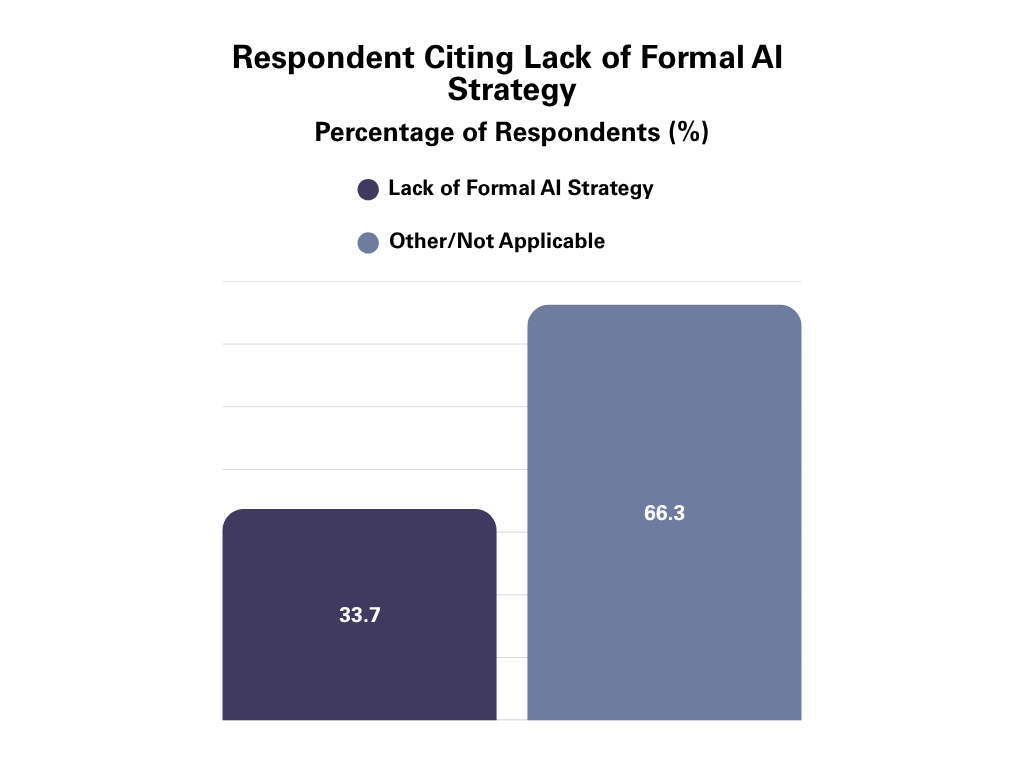
4. Lack of Formal AI Strategy is a Major Roadblock
A significant portion of respondents indicated that a lack of a formal AI strategy is a primary reason preventing adoption or expansion.
This barrier is closely linked to the lack of a clear business case and executive sponsorship.
CIO Insight: A formal AI strategy is the essential blueprint for a successful AI journey. Without one, organizations risk disjointed efforts, wasted resources, and a failure to demonstrate ROI. In 2026, CIOs should prioritize the development of a comprehensive strategy that defines use cases, establishes governance, and outlines a clear path to value.
5. ROI and Business Case Are Not Always Clear
Many organizations are struggling to quantify the tangible benefits and make a financial justification for large-scale AI investments.
33% of the respondents mentioned that the lack of a clear business case or ROI was a key barrier.
CIO Insight: Successful AI projects begin with a clear business problem. CIOs should work closely with business unit leaders to identify specific challenges—such as automating routine tasks or enhancing data analysis—and then develop AI pilot programs with measurable KPIs. Demonstrating a clear return on investment (ROI) is crucial for securing the funding and support needed to scale.